Thermal Volume Dynamics
In architectural design, the distance between the floor and the ceiling is not merely an aesthetic choice; it is a volumetric challenge for HVAC systems. Traditional forced-air systems are often calibrated for standard 2.4-meter (8-foot) ceilings. When that height increases to 3.5 meters or more, the air volume grows cubically, requiring exponentially more energy to maintain consistent temperatures at the living level.
Practitioners often observe the "stack effect," where warm air rises and accumulates near the roof, leaving the occupied zone—the bottom two meters of a room—significantly cooler. In a recent study by the ASHRAE (American Society of Heating, Refrigerating and Air-Conditioning Engineers), it was noted that for every additional meter of ceiling height, heating costs can rise by up to 15% if air destratification measures are not implemented.
Consider a modern loft in Berlin or a renovated warehouse in Brooklyn. Despite high-end boilers like Viessmann or Bosch being installed, residents often complain of cold feet. This happens because the thermostat, usually mounted 1.5 meters from the floor, satisfies its setting while the air at the 4-meter peak is 5-7 degrees Celsius warmer than the floor level.
The Physics of Stratification
Air density changes with temperature, causing hot air to float above cold air. In high-ceiling rooms, this creates distinct thermal layers. Without mechanical intervention, the heat you pay for stays where it is least useful: against the ceiling joists.
Energy Loss Mechanisms
Greater height increases the surface area of external walls. This creates more "thermal bridges" where heat escapes. Even with high-performance R-value insulation, the sheer scale of the building envelope in double-height living rooms leads to faster BTU (British Thermal Unit) loss.
Psychological Comfort Factors
Comfort is not just about air temperature; it is about Mean Radiant Temperature (MRT). Large, cold wall surfaces in tall rooms "suck" heat from the human body via radiation, making you feel chilly even if the air is technically 21°C.
Volumetric Load Calculations
Engineers use Manual J calculations to determine HVAC sizing. A room with 6-meter ceilings requires a significantly higher CFM (Cubic Feet per Minute) airflow to ensure that warm air actually reaches the floor before cooling and sinking.
Impact on Equipment Lifespan
When ceilings are high, furnaces and heat pumps work longer cycles to reach the setpoint. This increased duty cycle leads to premature wear on components like blower motors and heat exchangers in systems from brands like Carrier or Trane.
Structural Heat Pitfalls
The most common mistake in high-ceiling design is relying on "standard" heating layouts. Architects often prioritize the visual "wow" factor of a 5-meter atrium but fail to account for the 30% increase in load. This leads to oversized systems that short-cycle or undersized systems that never reach comfort levels.
Another critical pain point is the "Cold Pocket Syndrome." In open-concept spaces with mezzanines, heat naturally flows to the highest point of the house, often overheating the upstairs bedrooms while the ground-floor kitchen remains a refrigerator. This imbalance causes constant thermostat wars and spikes in monthly bills from providers like PG&E or National Grid.
In many luxury builds, floor-to-ceiling glass is paired with high ceilings. Without specialized perimeter heating (like trench heaters), the "cold downflow" from the glass creates a permanent draft at floor level. This renders the space uncomfortable for sedentary activities like watching TV or dining, regardless of how high the heater is turned up.
Engineering Comfort
To solve these issues, the approach must move from simple air heating to sophisticated climate management. Using radiant floor heating is the gold standard for high ceilings. Unlike forced air, radiant heat warms objects and people directly through infrared radiation, keeping the heat in the lower 2 meters of the room.
For existing structures where ripping up floors isn't an option, the installation of High-Volume Low-Speed (HVLS) fans, such as those from Big Ass Fans, is a game-changer. These fans operate in reverse during winter, pushing the trapped warm air down the walls to the floor level without creating a cooling breeze. This simple mechanical fix can reduce heating loads by 20-30%.
Smart zoning is another essential tool. Using systems like Honeywell Home or Ecobee with remote sensors allows the HVAC to prioritize the temperature where people actually sit. By placing sensors at "seated head height," the system ensures the living zone is optimized, rather than relying on a single hallway thermostat that doesn't represent the room's true climate.
Radiant Floor Integration
Systems like Uponor or Rehau hydronic piping turn the entire floor into a low-temperature radiator. Because the heat starts at the floor, the stratification curve is inverted, placing the highest warmth exactly where your feet are. This allows you to set the thermostat 2 degrees lower while maintaining the same comfort level.
Destratification Fans
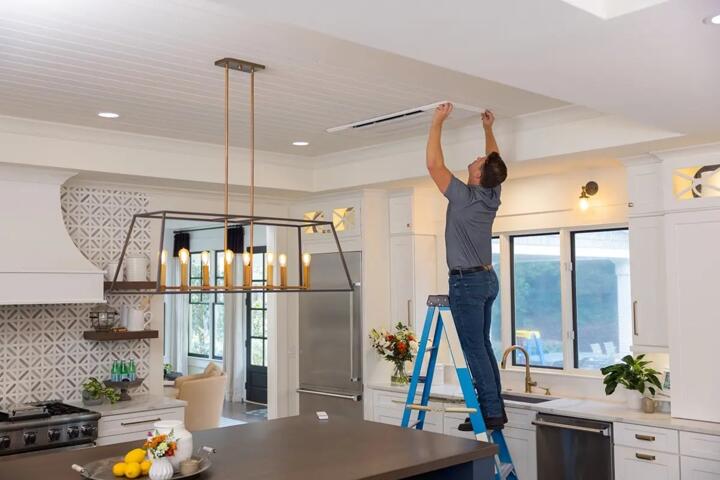
Small, whisper-quiet destratification pods like those from Airius can be recessed into the ceiling. They create a narrow column of air that breaks the thermal seal, mixing the air layers without the visual bulk of a traditional ceiling fan.
Advanced Window Treatments
Automated thermal shades from Lutron or Somfy can be programmed to close during peak cold hours. In high-ceiling rooms with massive windows, these shades act as an extra layer of insulation, preventing the "convective loop" where air cools against the glass and drops to the floor.
Strategic Duct Placement
Instead of placing supply vents in the ceiling (the most common error), experts recommend "low-supply, high-return" configurations. Pushing warm air out at floor level forces it to rise through the living space, while high-level returns capture the rising heat to be recirculated.
Thermal Mass Utilization
Incorporating materials like stone or thick plaster in the lower half of walls helps "anchor" the heat. These materials absorb thermal energy during the heating cycle and release it slowly, buffering the temperature swings common in large-volume spaces.
Real-World Performance
A residential project in Seattle involved a 4.5-meter ceiling living room that cost the owners over $450 a month in winter heating using standard electric baseboards. The air at the ceiling was measured at 28°C, while the floor stayed at 18°C. By replacing the baseboards with a Mitsubishi Hyper-Core ductless mini-split and adding a single 60-inch destratification fan, the floor temperature rose to 21°C within 30 minutes. The monthly energy bill dropped to $210, a 53% saving.
In a commercial setting, a boutique car showroom with 6-meter ceilings struggled with employee comfort. They installed gas-fired infrared tube heaters (like those from Roberts Gordon). These units don't heat the air; they heat the cars and the floor. The result was a 40% reduction in gas consumption compared to their previous forced-air rooftop units, as they no longer needed to "fill" the entire 6-meter volume with hot air.
Optimization Checklist
| Action Item | Target Outcome | Estimated ROI |
|---|---|---|
| Install Radiant Flooring | Eliminate stratification; heat the "living zone" first. | High (10-15 years) |
| Reverse Ceiling Fans | Push trapped heat down from the ceiling to the floor. | Immediate (1 season) |
| Add Remote Sensors | Ensure thermostat reads temperature at person-level. | Fast (1-2 years) |
| Seal Thermal Bridges | Prevent heat leak at wall-to-roof junctions. | Medium (3-5 years) |
| Trench Heaters | Block cold drafts from large floor-to-ceiling windows. | Medium (5-7 years) |
Oversight Blunders
The biggest mistake is the "More Power" fallacy. Adding a larger furnace to a room with high ceilings doesn't fix the cold floor; it just makes the ceiling hotter and the air dryer. This leads to "baked" air that feels stuffy and causes static electricity issues, while your feet remain cold.
Neglecting the "Return Air" path is another frequent error. If your HVAC only pulls air from a vent at the floor, it never circulates the hottest air trapped at the top. Installing a high-level return vent (near the ceiling) is a low-cost renovation that allows the furnace to "re-use" the heat it already generated, drastically increasing efficiency.
FAQ
Do high ceilings always mean high heating bills?
Not necessarily. While the volume is greater, high-performance insulation (SIPs or spray foam) combined with radiant heating can make a tall room as efficient as a standard one.
What is the best fan setting for winter?
Fans should spin clockwise at a low speed. This pulls cool air up and gently nudges the warm air trapped at the ceiling down the walls to the floor.
Are mini-splits effective for high ceilings?
Yes, but placement is key. Mounting a wall unit too high will cause it to cycle off prematurely as it sucks in the hot air rising from the room. It should be mounted at a medium height or use a floor-mounted console unit.
How does humidity affect comfort in tall rooms?
Dry air feels colder. In large volumes, maintaining 40-50% humidity via a whole-home humidifier (like AprilAire) allows you to feel comfortable at lower temperatures, saving energy.
Should I use curtains in a double-height room?
Yes. Heavy, floor-to-ceiling thermal drapes are incredibly effective at stopping the "waterfall" of cold air that slides down large glass panes in winter.
Author's Insight
In my fifteen years of HVAC consulting, I’ve seen homeowners spend thousands on "smart" gadgets while ignoring the basic laws of physics. If you have ceilings over 3 meters, my top piece of advice is to stop looking at the furnace and start looking at the air movement. A $200 fan or a $500 duct modification often does more for comfort than a $10,000 boiler upgrade. Don't fight the heat rising—give it a mechanical reason to come back down.
Summary
Managing the thermal environment of a high-ceiling space requires a shift from heating air to heating surfaces and managing airflow. By prioritizing radiant heat sources, utilizing destratification technology, and ensuring smart sensor placement, you can enjoy the architectural beauty of a tall room without the penalty of astronomical energy bills. Focus on the bottom two meters of the room; that is where comfort happens.