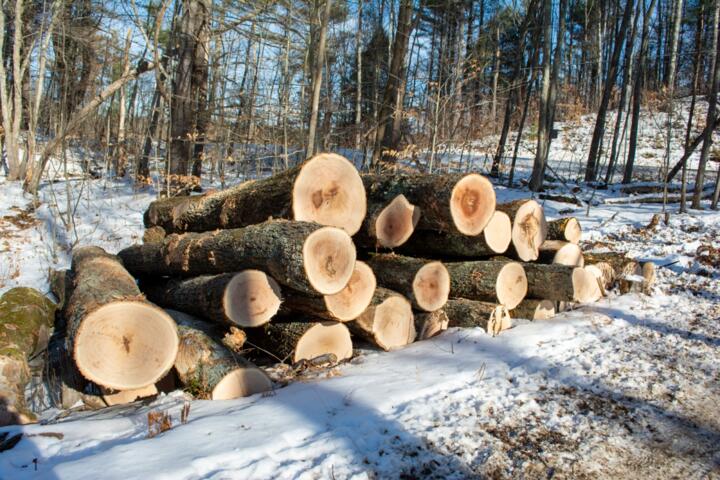
High-Value Forest Assets
Managing a woodlot for furniture-grade timber is an exercise in patience and biological engineering. Unlike industrial forestry, which prioritizes biomass and volume for paper or construction lumber, furniture-grade management focuses on the quality of the "heartwood" and the elimination of knots. A single veneer-quality White Oak log can fetch $1,500 to $5,000 at auction, whereas the same volume of pallet wood might only be worth $60.
In practice, this means identifying "Crop Trees"—those with the straightest boles and healthiest crowns—and giving them the resources to thrive. For instance, in a 10-acre hardwood stand in Pennsylvania, a landowner might select only 30 to 50 trees per acre as primary furniture candidates. According to the U.S. Forest Service, high-quality sawtimber prices have historically outpaced inflation by 1-3% annually, making woodlots a stable alternative asset class.
Assessing Site Quality and Species Fit
Success begins with understanding your soil's Site Index (SI). Furniture-grade hardwoods require deep, well-drained loamy soils to prevent mineral staining and "shake" (internal wood separation). Use the Web Soil Survey (WRC) to check if your land supports species like Black Walnut, which demands high nitrogen and moisture, or White Oak, which thrives on slightly drier ridges. Planting the wrong species on a poor site leads to "stress-induced figure," which sounds nice but usually results in brittle, unsellable timber.
The Science of Crown Release
To grow wide-diameter logs quickly, you must manage the canopy. "Crown Release" involves removing "competitor trees" that touch the crown of your selected Crop Tree. When a tree has space on at least three sides of its crown, its diameter growth rate can double. Research from Purdue University’s Department of Forestry shows that released hardwoods can reach harvestable sawtimber size (20-24 inches DBH) 20 to 30 years faster than those in unmanaged, crowded stands.
Mastering Pruning for Clear Lumber
Furniture makers demand "clear" wood—lumber without knots. Knots are simply buried branches. By performing "lift pruning" (removing lower branches while they are under 2 inches in diameter), you ensure that subsequent wood growth is defect-free. Always use a Silky Hayauchi pole saw for clean cuts that heal quickly. Never prune more than one-third of the live crown at once, as this stresses the tree and invites epicormic branching, which ruins the grain pattern.
Managing Stand Density for Stability
Total basal area (BA) is the metric of success. For furniture timber, you want to maintain a BA of 70-90 square feet per acre. If the stand is too dense, trees become spindly and prone to windthrow. If it is too thin, the trees will grow "fat and squat" with too many side branches. Tools like a Cruz-All or a simple wedge prism help you calculate BA accurately. Maintaining this balance ensures the wood develops tight, even growth rings, which furniture makers prize for structural stability.
Protection from Biotic and Abiotic Stress
High-value timber is a target for pests and climate stress. In the Midwest and Northeast, the Emerald Ash Borer has decimated stocks, making Ash less viable for long-term furniture projects. Monitor for "canker" sores or fungal shelf growths. Protecting the "butt log" (the bottom 8-16 feet) is critical because 70% of a tree's furniture value is contained in this section. Avoid using heavy machinery like skid steers near Crop Trees to prevent soil compaction and root damage.
Woodlot Oversight Failures
The most common mistake is "high-grading," often disguised as "selective thinning." This happens when a logger takes only the best trees, leaving the "genetic runts" to repopulate the forest. This degrades the long-term value of the land. Another pain point is ignoring invasive species like Buckthorn or Oriental Bittersweet. These vines can strangle a young veneer-grade Cherry tree in three seasons, causing permanent deformities in the trunk.
Failure to document management also hurts value. When it comes time to sell, buyers like Danzer or local boutique sawmills want to see a management history. Without a written forest management plan, you are just selling "trees"; with a plan, you are selling a "managed resource." Neglecting the transition from the first log to the second log (the section above 16 feet) also leaves money on the table; proper pruning can turn a "Grade 3" log into a "Grade 1" log over a decade.
Timber Quality Strategy
To maximize ROI, implement a "Crop Tree Management" (CTM) system. Start by marking your best trees with blue forestry paint. These are your "winners." Every action you take should benefit these specific individuals. Use a Husqvarna 550 XP or similar professional-grade chainsaw for directional felling of competitors to ensure you don't "skin" the bark of your Crop Trees during the process.
On a practical level, this involves a 10-year cycle. Year 1: Inventory and invasive control using Garlon 4 Ultra for basal bark treatment. Year 2-3: First thinning and lift pruning. Year 5: Follow-up pruning. Year 10: Re-evaluate growth rates using a diameter tape. This systematic approach ensures you aren't just "gardening" but actually producing a commodity. Targeted fertilization with slow-release nitrogen can be used in small woodlots, but only after a soil test confirms a deficiency, as over-fertilizing can lead to "loose" grain that is undesirable for fine woodworking.
Precision Forestry Cases
Case 1: The Ohio Walnut Orchard
A private landowner with 15 acres of mixed hardwoods identified 200 Black Walnut saplings. By investing $2,000 in invasive species removal and professional pruning over five years, the average diameter growth increased from 0.15 inches to 0.35 inches per year. The projected value of the stand at age 50 increased from $45,000 to an estimated $110,000 due to the transition from "common" to "prime" grade logs.
Case 2: New England Maple Restoration
A small furniture maker purchased 8 acres of neglected forest. The stand was overcrowded with Red Maple and Beech. By removing the Beech (which was prone to bark disease) and thinning the Red Maple to a BA of 80, the landowner induced "curly" figure in several trees due to managed stress and genetic selection. Ten years later, the first harvest of three "figured" logs sold to a specialty luthier supplier for $8,000, more than the cost of the original thinning equipment.
Timber Management Table
| Management Style | Target Species | Thinning Cycle | Pruning Required? | Primary Market |
|---|---|---|---|---|
| Passive Management | Mixed Hardwood | None (Natural) | No | Firewood / Pallets |
| Industrial Forestry | Pine / Poplar | 15-20 Years | Minimal | Construction / Pulp |
| Furniture Grade | Oak / Walnut / Cherry | 5-7 Years | Yes (Up to 17ft) | Fine Furniture / Veneer |
| Specialty (Luthier) | Maple / Spruce | Individual Basis | Very High | Musical Instruments |
Silviculture Errors
One major error is "flush cutting" when pruning. You must leave the "branch collar"—the swollen area where the branch meets the trunk. Cutting into this collar prevents the tree from sealing the wound, leading to rot and internal "pockets" in the lumber. Also, avoid "over-thinning." Removing too many trees at once exposes the remaining ones to sunscald and wind-throw.
Don't ignore the market timing. Furniture trends shift. While "Grey Oak" was popular for a decade, natural "Live Edge" Walnut and "White Oak" remain timeless. Align your species selection with long-term market indicators from the Hardwood Market Report (HMR). Finally, never sell your timber on a "lump sum" basis without an independent appraisal; always sell by the board foot or via a competitive bid process to ensure you capture the "furniture grade" premium.
FAQ
How long does it take to grow furniture-grade timber?
Depending on the species and site quality, it typically takes 40 to 80 years. However, active management like crown release can shorten this window by up to 30% by maximizing annual diameter growth.
Is Black Walnut always the most profitable choice?
Not necessarily. While Walnut has high value per board foot, it requires very specific soil conditions. High-quality White Oak or "Curly" Maple can often exceed Walnut prices if the quality and grain pattern are exceptional.
Do I need a professional forester for a small plot?
Yes. A Certified Forester (SAF) can help you set up a management plan that qualifies for "Current Use" tax breaks, which can save you thousands in property taxes while your trees mature.
What is the minimum acreage for a viable woodlot?
For personal use or boutique sales, even 2-5 acres can be managed intensively. For commercial viability where a logger needs to bring in equipment, 10-20 acres is usually the practical minimum.
Can I graze livestock in my woodlot?
No. Cattle, horses, and goats compact the soil and eat the bark/seedlings of high-value hardwoods. Grazing is the fastest way to destroy the future value of furniture-grade timber.
Author’s Insight
In my years of observing forest dynamics, I've realized that the best woodlot managers aren't loggers; they are "tree coaches." You aren't just waiting for nature to take its course; you are actively selecting for the straightest, most resilient specimens and removing everything that stands in their way. My biggest piece of advice: buy a high-quality diameter tape and use it every spring. Seeing a 0.5-inch increase in a prized Walnut’s girth is as satisfying as watching a stock portfolio grow, and far more tangible. Focus on the first 16 feet of the tree; that is where your mortgage will be paid off.
Summary
Managing a woodlot for furniture-grade timber is a high-leverage strategy that turns a static piece of land into a dynamic production facility. By focusing on site-species matching, rigorous pruning, and precise crown release, you ensure your forest produces clear, high-value sawlogs rather than low-grade pulp. Start by identifying your Crop Trees this season and removing one major competitor from each. This single act of "releasing" your best timber is the first step toward a multi-generational legacy of fine woodcraft and financial return.