Infrastructure Basics
A workshop is more than four walls; it is a complex machine where electricity, air quality, and spatial logic must synchronize. In a professional setting, the layout determines the workflow, while the utilities determine the capacity for growth. A common baseline for a medium-duty shop is a 100-amp sub-panel, providing enough headroom for a 220V table saw and a 1.5 HP dust collector to run simultaneously without tripping breakers.
Practically, this means mapping your "work triangles"—the distance between your primary workbench, your largest stationary tool, and your material storage. In a recent study of small manufacturing hubs, efficient spatial planning reduced "traversed distance" by 30%, directly translating to higher hourly output. Industry standards suggest maintaining at least 36 inches of clearance around major machinery to ensure safe operator movement.
Calculating Total Electrical Load
Estimating power needs requires looking at "startup surge" rather than just running wattage. Most induction motors found in planers or lathes require three times their running amperage to start. If you are using a 15-amp tool on a 20-amp circuit, the initial spike can weaken the breaker over time. Professionals use the 80% rule: never load a circuit continuously beyond 80% of its rated capacity.
Zoning for Dust and Fumes
Atmospheric management isn't just about comfort; it's about lung health and finishing quality. A workshop should be zoned into "Dirty" (sanding/cutting), "Clean" (assembly/finishing), and "Mechanical" (compressors/vacuums). By isolating the dust-producing activities, you can implement localized extraction using systems like those from Oneida Air Systems, which can capture 99% of fine particles before they become airborne.
Ergonomic Vertical Integration
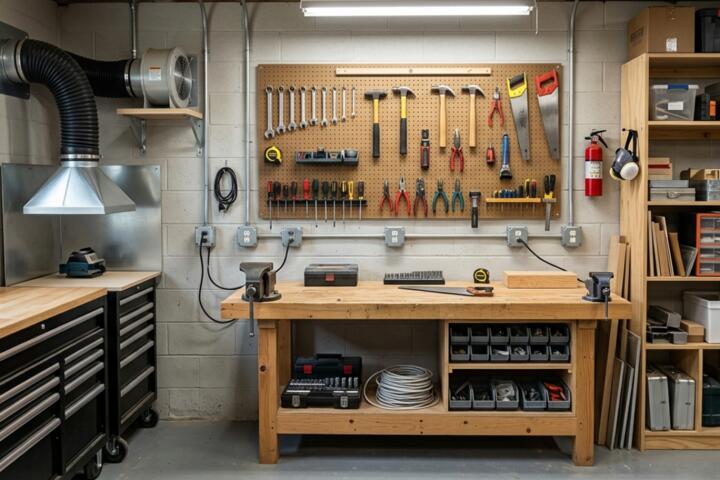
Storage should follow the "Golden Zone" principle: items used daily stay between knee and shoulder height. Heavy items like floor jacks or bulk lumber go low, while seasonal items go high. Using French Cleat systems allows for a modular environment that evolves with your tool collection. This prevents the "storage creep" that eventually consumes valuable floor real estate.
Lighting for Precision and Safety
Standard residential lighting is insufficient for high-detail work. A professional shop requires a minimum of 75 to 100 foot-candles at the work surface. Switching to high-CRI (Color Rendering Index) LED shop lights, such as those from Barrina or Honeywell, ensures that color matching and surface imperfections are visible. Proper lighting reduces eye strain, which is a leading cause of fatigue-related accidents.
The Role of Compressed Air
A dedicated air line system, using materials like RapidAir or MaxLine, eliminates the trip hazard of hoses stretched across the floor. Plumbing your shop with drops at every major workstation allows for instant access to pneumatic nailers, blow-off nozzles, and sanders. This infrastructure upgrade is often overlooked but provides the most significant "pro-feel" boost to any workspace.
Critical Shop Failures
The most common mistake in workshop design is underestimating the hidden costs of "making it work." Using standard extension cords for high-draw tools leads to voltage drops, which causes motors to run hot and fail prematurely. In 2024, electrical malfunctions remained a top cause of fire in non-residential structures, often traced back to overloaded power strips and daisy-chained cords.
Another frequent oversight is "dead-air" pockets in ventilation. Many builders install a powerful exhaust fan but forget the intake, creating a vacuum that prevents air movement. Without a balanced CFM (Cubic Feet per Minute) exchange, toxic VOCs from finishes and adhesives linger at nose level. This doesn't just smell bad; it causes long-term respiratory issues and compromises the drying process of paints and resins.
Optimized Integration
To build a world-class space, you must treat the utilities as an integrated network. For electricity, this means installing 20-amp GFCI outlets every four feet along workbenches. This allows you to plug in multiple small tools—like routers, drills, and chargers—without hunting for a socket. For high-demand machinery, dedicated 220V circuits are non-negotiable for maintaining torque and efficiency.
Ventilation should be dual-layered. Use a high-volume ambient air cleaner (like a Jet or Shop Fox unit) to scrub the air of fine dust, paired with an active exhaust system for chemical fumes. Real-world testing shows that a dual-stage dust collector with a 1-micron filter is 10 times more effective at protecting health than a standard shop vacuum. This setup ensures that the air is changed at least 6-8 times per hour.
Storage solutions must prioritize "visibility over density." If you can't see a tool, you won't use it. Clear-front bins for fasteners and shadowed tool boards (Shadowing) for hand tools reduce the time spent searching. Statistics suggest that the average tradesperson loses up to 40 minutes a day looking for misplaced tools. Professional-grade cabinets from brands like Husky or Milwaukee provide the structural integrity needed to hold hundreds of pounds of steel without sagging.
Workshop Success Stories
A boutique furniture maker in Oregon struggled with a 400-square-foot garage that constantly felt cluttered. Their main issue was a 1.5 HP table saw that kept tripping a shared 15-amp lighting circuit. After a professional audit, they installed a 60-amp sub-panel, separated the lighting from the tool circuits, and implemented a vertical wood rack. The result was a 25% increase in project turnaround time and zero electrical downtime over the following twelve months.
A small automotive restoration shop faced complaints from neighbors regarding fumes. They were relying on open doors for "cross-ventilation," which was ineffective. By installing a 2000 CFM explosion-proof exhaust fan and a dedicated paint booth area with intake filters, they reduced VOC levels by 85%. This not only satisfied local environmental regulations but also improved the quality of their clear-coat finishes by eliminating airborne contaminants.
Technical Comparison
| Feature | Standard DIY Level | Professional Grade | Industrial Specification |
|---|---|---|---|
| Electrical Supply | 15A Shared Circuits | 20A Dedicated + 220V | 3-Phase Power / 200A+ |
| Dust Collection | Shop Vac (No Filter) | 1.5HP Cyclonic + HEPA | Centralized 5HP+ System |
| Air Exchange | Passive (Windows) | Active Exhaust (4-6 ACH) | HVAC with Filtration (10+ ACH) |
| Tool Storage | Plastic Tubs / Shelves | French Cleats / Tool Chests | High-Density Vidmar Cabinets |
| Lighting | Incandescent Bulbs | 4000K LED (75 fc) | 5000K High-Output (100+ fc) |
Avoiding Strategic Errors
Never skimp on the wire gauge. While 14-gauge wire is cheaper, 12-gauge is the minimum for any 20-amp circuit. Using the wrong gauge creates resistance, which generates heat and wastes energy. Always plan for 20% more outlets than you think you need; the cost of adding a box during construction is negligible compared to the cost of an electrician returning later.
Avoid placing your main workbench in a corner. "Islanding" your primary work surface allows you to walk around large projects and process long boards without hitting walls. Furthermore, ensure your flooring can handle the load. Standard garage concrete is usually 4 inches thick, which is fine, but if you're installing a heavy milling machine, you may need a reinforced pad to prevent cracking and vibration transfer.
FAQ
What is the best way to ventilate a basement workshop?
Basements require active "make-up air." You need an intake fan at one end and an exhaust fan at the other to create a directional flow. Using a carbon filtration system is also recommended if you cannot vent directly outside due to neighborhood restrictions.
Do I really need 220V for my workshop tools?
While many tools run on 110V, 220V is significantly more efficient for motors over 1.5 HP. It allows the motor to run cooler and draw half the amperage, which extends the life of the machine and provides more consistent power under heavy load.
How do I prevent rust on tools in a humid workshop?
The key is a combination of climate control (dehumidifier) and surface protection. Keeping the humidity below 50% is the gold standard. For cast-iron surfaces, using a product like Boeshield T-9 or Paste Wax provides a moisture barrier that prevents oxidation.
How many lumens do I need for a 20x20 garage?
For a high-productivity workshop, aim for approximately 30,000 to 40,000 total lumens. This can be achieved with six to eight 4-foot LED wrap-around fixtures. Distributed light is always better than one or two high-intensity "hot spots."
Is a French Cleat system better than Pegboard?
French Cleats are superior for heavy tools and custom holders because they distribute weight across a larger surface area. Pegboards are fine for lightweight hand tools but often fail under the weight of power tools or heavy clamps.
Author's Insight
In my twenty years of managing industrial spaces, I've learned that the most expensive tool in the shop is the one you have to move three times to get to something else. Efficiency is born from friction-less movement. My best advice is to paint your walls bright white and your floors a light grey; the reflected light will save you more money on electricity and eye strain than any "high-end" gadget ever could. Build for the workflow you want, not the one you currently have.
Summary
Designing a superior workshop requires a disciplined approach to electrical safety, air quality management, and organizational logic. By moving away from "temporary" solutions—like extension cords and passive ventilation—and investing in dedicated circuits, cyclonic dust collection, and modular storage, you create a space that supports professional-level output. Prioritize your infrastructure first; the quality of your work will naturally follow the quality of your environment. Start by auditing your current electrical load and mapping your airflow to identify the most impactful upgrades for your specific needs.