LFP Vs NMC For Storage
Off-grid battery storage turns intermittent power from solar panels or a generator into usable electricity for lights, refrigeration, water pumps, and communications. The chemistry inside the battery pack shapes how much of that stored energy you can actually use, how the battery tolerates charging and discharging, and how it behaves in heat or cold.
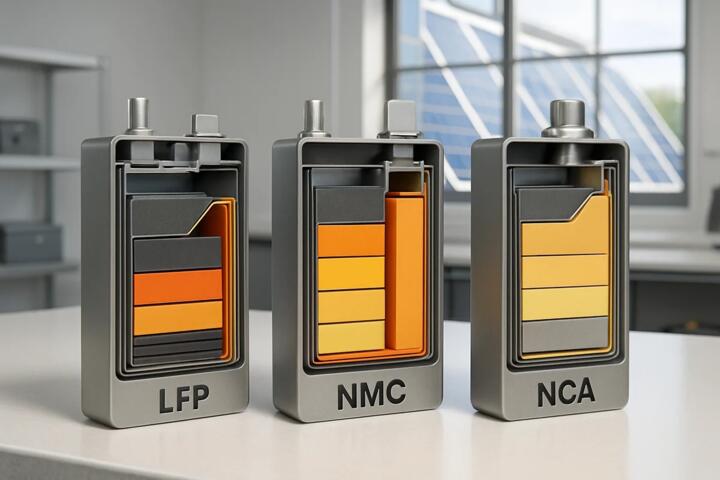
LFP (lithium iron phosphate) and NMC (lithium nickel manganese cobalt) both use lithium-ion cell designs, but they differ in cathode chemistry. That difference shows up as different voltage curves, different charge acceptance behavior, and different tradeoffs between energy density and cycle life. In practical off-grid terms, you’re choosing between a battery bank that tends to last through many cycles with conservative charging, and one that often stores more energy per unit mass or volume but demands tighter operating conditions.
Example: a solar system that charges during midday and runs loads at night may cycle the battery daily. If the battery is frequently pushed near its limits, the chemistry’s tolerance for high state-of-charge and high charge rates becomes a deciding factor. Another example: a backup system for a well pump and a fridge during outages may sit at high charge for long periods, which changes how you should manage charging targets and float behavior.
Most off-grid failures people blame on “the battery” trace back to system dependencies: inverter/charger firmware settings, battery management system (BMS) limits, wiring and fusing, and temperature. A chemistry choice helps, but it does not replace correct configuration. I’ve seen this in logs from common inverter brands where the battery charge limit was set too high for the installed pack, and the BMS spent most of its time throttling charge—annoying, and it rarely works the way the docs say.
Common Off-Grid Battery Pain
Many buyers compare LFP and NMC using only headline capacity or price per kilowatt-hour. That approach misses how usable capacity changes with voltage limits, temperature, and the BMS’s protection thresholds. A battery spec may list a nominal capacity, yet the system may only access a portion of it because the inverter stops discharge at a conservative cutoff voltage.
Another frequent mistake is ignoring charging strategy. LFP packs often perform best when charged to a moderate maximum state-of-charge for daily cycling, while NMC packs may tolerate higher charge targets in some designs but can age faster if held at high voltage for long periods. Off-grid owners who set “100%” charge because it feels safer can end up with accelerated degradation, especially when the battery sits full during extended cloudy weather.
Temperature management is a second dependency. Cold reduces available power and can slow charge acceptance; hot conditions increase stress. Some packs include active or passive thermal management, but many residential off-grid setups rely on ambient conditions and insulation. If your battery bank lives in an unventilated shed, the chemistry’s heat sensitivity matters as much as the cell type.
Finally, people underestimate how inverter settings interact with the BMS. The inverter may attempt to follow a charge profile, but the BMS can override it by limiting current or voltage. When the BMS repeatedly clamps charge current, you may see slower solar charging and longer generator runtime—then the owner changes settings again, and the cycle continues. In one case I reviewed (firmware 2.3.x on a popular inverter model), the charge current limit was set to a value the BMS could not accept at typical winter temperatures, so the system spent hours at reduced charging power.
How To Choose And Size
Match Chemistry To Use Pattern
Start with how the battery is used: daily cycling, seasonal storage, or mostly standby. For daily cycling with solar, LFP’s typical cycle-life advantage and conservative voltage behavior often fit well, especially when you plan to charge to a moderate maximum state-of-charge. For standby backup where the battery may sit near full for long stretches, you still need a charging target that avoids prolonged high voltage; NMC can work, but the system must be configured to reduce time spent at high state-of-charge.
Look for pack-level documentation that states recommended maximum charge voltage, charge current limits, and temperature ranges. Cell chemistry alone does not tell you the usable window; the BMS does. If the supplier provides only cell-level data and not pack-level limits, treat that as a risk for off-grid planning.
Use Real Load Numbers For Sizing
Battery sizing should begin with your daily energy use in watt-hours, not your peak power. If your fridge uses 1.2 kWh per day, lights and electronics use 0.6 kWh, and a water pump uses 0.4 kWh, your daily total is 2.2 kWh. Add charging losses and inverter losses; a common planning range is 10–20% extra energy to cover inefficiencies, depending on system design and wiring.
Then decide how many days of autonomy you want. A two-day outage plan for 2.2 kWh/day means 4.4 kWh delivered to loads. If your system only uses, for example, 80% of the battery’s nominal capacity due to discharge limits, you’d plan for about 5.5 kWh nominal battery capacity. The exact usable fraction depends on the inverter cutoff settings and the BMS discharge limits, which vary by manufacturer.
As a practical aside, I often see owners size for energy but forget surge power for pumps and compressors. A battery chemistry choice does not remove the need to check inverter surge capability and wiring gauge. If the inverter trips on surge, the battery chemistry becomes irrelevant.
Set Charge Limits And Targets
Configure the inverter/charger to respect the battery’s recommended charge voltage and maximum charge current. For LFP, many systems use a maximum state-of-charge target below 100% for daily cycling, then allow a higher charge only for specific maintenance cycles if the manufacturer recommends it. For NMC, the pack may tolerate higher charge targets, but aging can still accelerate when held at high voltage for long periods.
Use temperature-aware settings when available. Some inverters support temperature compensation for charge voltage; if your battery is in a cold location, fixed voltage targets can undercharge or over-stress the pack. If your inverter menu shows a “battery temperature sensor” option, connect it to the pack sensor rather than relying on ambient temperature.
One mild frustration: many installers set “battery type” profiles and never verify the resulting charge current limit against the BMS datasheet. A quick check with a clamp meter or the inverter’s charge-current readout during a sunny period can reveal whether the BMS is throttling early.
Plan For Safety And Ventilation
Both LFP and NMC are lithium-ion chemistries and require correct installation practices. Use the manufacturer’s specified fusing, cable sizing, and disconnects. Ensure the battery enclosure meets the pack’s requirements for ventilation or thermal isolation; some packs are designed for sealed enclosures, others are not.
Fire safety planning matters for off-grid homes because you may not have rapid municipal response. Follow local electrical codes and the battery manufacturer’s installation instructions. In the United States, residential battery systems are commonly evaluated under the National Electrical Code (NEC), and the exact requirements can vary by jurisdiction and system configuration.
Also check how the BMS handles faults. A good sign is clear documentation of overcurrent, overvoltage, undervoltage, and temperature protections. A red flag is vague language without measurable thresholds.
Educational Case Examples
Scenario A: Solar Cabin With Daily Cycling
A cabin uses solar during the day and runs loads at night. The owner wants two days of autonomy and expects daily cycling most of the year. They choose an LFP-based battery pack and set the inverter’s maximum charge state to a moderate target recommended by the manufacturer, then allow a higher charge only when the system reaches a full charge condition. During winter, the inverter’s temperature-compensated charge profile reduces undercharging, and the BMS limits charge current when cold. The owner tracks daily energy delivered and notices solar charging takes longer in cold weeks, but the system stays within the pack’s current and voltage limits.
Scenario B: Backup Power For Critical Loads
A home stores power mainly for outages affecting a well pump, a fridge, and internet equipment. The battery sits at high charge for long periods. The owner selects an NMC-based pack but configures the inverter to avoid prolonged time at maximum voltage by using a lower daily charge target and a scheduled equalization or maintenance charge only if the manufacturer recommends it. When an outage occurs, the inverter draws power within the pack’s discharge limits. After several months, the owner compares expected capacity retention to the pack’s warranty guidance and confirms the system logs show no repeated over-temperature events.
LFP Vs NMC Checklist
| Decision Factor | LFP Tends To Fit | NMC Tends To Fit | What To Verify In Docs |
|---|---|---|---|
| Daily cycling | Frequent charge/discharge with conservative charge targets | Cycling when charge/hold settings match manufacturer guidance | Cycle-life test conditions and usable capacity window |
| Energy density | More mass/volume per kWh is acceptable | Space or weight constraints matter | Pack-level kWh, dimensions, and weight |
| Charge acceptance | Often tolerates conservative charging well | May require tighter charge limits to avoid stress | Max charge current by temperature and max charge voltage |
| High state-of-charge storage | Works when you avoid prolonged full charge if advised | Works when you manage time at high voltage | Recommended storage state-of-charge and maintenance charge rules |
| Cold weather | Charge may slow; plan for temperature limits | Charge may also slow; verify temperature derating | Operating temperature range and derating curves |
Step-by-step checklist for decision support
- List your daily energy use (Wh/day) and your target autonomy days.
- Confirm inverter/charger compatibility with the battery’s nominal voltage and BMS communication method (if used).
- Record the battery’s recommended charge voltage, max charge current, discharge cutoff, and temperature range from the pack datasheet.
- Choose a daily charge target that matches the manufacturer’s guidance for cycling or standby use.
- Plan for cold charging behavior by checking temperature derating and expected solar charge time.
- Verify electrical safety requirements: fusing, cable sizing, disconnects, and enclosure ventilation rules.
Common Mistakes To Avoid
One mistake is buying a battery chemistry and assuming it fixes system configuration. If the inverter is set to a generic profile that does not match the pack’s voltage limits, the BMS will throttle charging or the inverter will cut off early. The result looks like “bad battery performance” when the root cause is mismatched settings.
Another mistake is treating the battery’s rated capacity as fully usable. Discharge cutoffs and inverter low-voltage limits reduce usable energy, and those limits differ by chemistry and by pack. If you size for 10 kWh nominal but only 7.5 kWh is usable in your configuration, your autonomy plan fails during the first long outage.
People also skip temperature-aware planning. A battery that charges slowly in winter can lead to longer generator runtime, which increases fuel costs and maintenance. If the battery is in a cold enclosure, add insulation or heating only if the manufacturer supports it; improvising heat sources can violate safety guidance.
Finally, owners sometimes ignore warranty language tied to operating conditions. Many warranties depend on charge/discharge ranges, temperature limits, and proper installation. If you operate outside those ranges, the warranty may not cover degradation.
FAQ
Which Chemistry Lasts Longer?
LFP packs often show higher cycle life in many manufacturer test conditions, but cycle life depends on charge voltage, depth of discharge, and temperature. NMC packs can still last well when operated within the pack’s recommended limits and when time at high state-of-charge is controlled.
Can I Mix LFP And NMC?
Mixing different chemistries in the same battery bank is generally not recommended because voltage curves and BMS behavior differ. Use one chemistry per bank and match the inverter settings to that pack’s datasheet.
What Charge Target Should I Use?
Use the maximum charge voltage and state-of-charge target specified by the battery manufacturer for your use case (daily cycling vs standby). Many systems avoid holding at full charge for long periods, but the exact target varies by pack design.
How Cold Affects Charging
Cold temperatures reduce charge acceptance and can trigger BMS current limits. Check the pack’s temperature range and derating curves, then plan for slower solar charging and longer generator charging during winter.
Do Inverters Change The Outcome?
Yes. Inverter/charger charge profiles, discharge cutoffs, and temperature compensation determine how much of the battery’s capacity you can use and how often the BMS throttles. Confirm the inverter settings match the pack’s documented limits.
Author's Insight
Battery chemistry matters, but off-grid outcomes usually track configuration quality: charge targets, temperature-aware settings, and correct inverter-to-BMS behavior. LFP and NMC both rely on pack-level limits, so the most useful comparison comes from datasheets that state voltage, current, temperature derating, and cycle-life test conditions. When those details are missing, planning becomes guesswork and the system’s real-world performance can diverge from marketing claims.
For readers building or upgrading an off-grid system, the fastest path to clarity is to write down your daily Wh/day, your autonomy days, and your expected winter temperatures, then map those numbers to the battery’s documented operating window. That approach turns “chemistry choice” into a measurable design decision.
Key Takeaways
- LFP and NMC differ in how they handle cycling, high state-of-charge storage, and temperature limits, but pack-level BMS rules decide the usable window.
- Size batteries using Wh/day and autonomy days, then apply your inverter and BMS discharge limits to estimate usable energy.
- Set inverter charge voltage/current to match the battery datasheet and use temperature compensation when available.
- Plan for cold charging behavior and verify electrical safety requirements under local code and manufacturer instructions.