Voltage Management
A charge controller acts as the gatekeeper between your energy source and your storage. Its primary job is to prevent battery overcharging while ensuring the panels operate at an optimal level. Without this bridge, a 12V battery connected directly to a high-voltage panel would likely overheat or suffer a shortened lifespan due to unregulated current spikes.
In practical field applications, using an undersized controller often leads to "clipping," where excess energy is simply wasted as heat. For instance, a standard 100W panel might produce 18V at its peak, but a lead-acid battery only needs about 14.4V to charge. The controller must bridge this 3.6V gap efficiently to prevent hardware degradation.
Real-world data from systems using Victron Energy hardware shows that switching from basic regulation to active tracking can increase total energy harvest by up to 30% in colder climates. Statistics indicate that for every 10 degrees Celsius the temperature drops, the efficiency gap between these two technologies widens significantly.
System Inefficiencies
The most common mistake in DIY solar setups is "voltage mismatching." Many users pair high-voltage grid-tie panels with low-cost PWM controllers, unaware that a PWM unit can only pull the panel voltage down to the battery level. This results in the immediate loss of all potential power above the battery's nominal voltage, essentially turning a 300W panel into a 150W one.
Thermal runaway and poor heat dissipation are secondary pain points. Lower-tier controllers often lack adequate heat sinks, leading to internal component failure when operating at 90% capacity during peak summer months. When a controller fails, the battery bank—often the most expensive part of the system—is left vulnerable to deep discharge or overvoltage.
In a recent diagnostic for a remote telecommunications site, we found that using mismatched components led to a 40% loss in daily uptime. The site owners were forced to replace a $2,000 lithium-ion bank prematurely because the controller could not communicate correctly with the Battery Management System (BMS), leading to improper cell balancing.
The Limitations of PWM
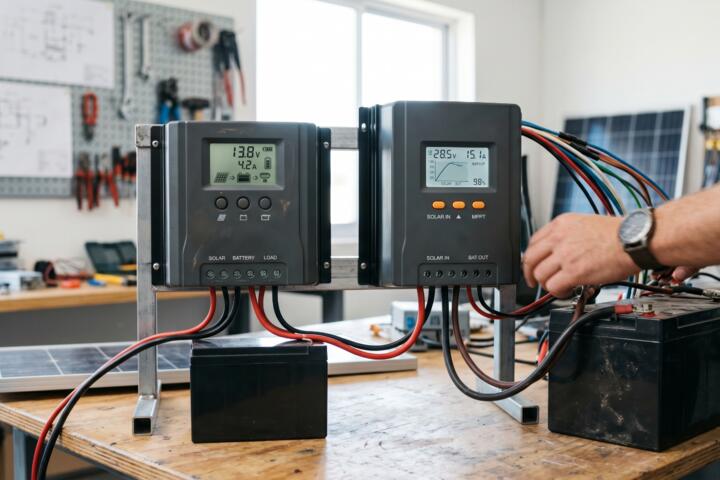
PWM technology works like a rapid "on/off" switch. As the battery approaches full charge, the controller reduces the width of the pulses to maintain a steady voltage. While reliable, it lacks the ability to transform "extra" voltage into additional current, making it inherently less efficient for large-scale arrays.
MPPT Advantage Explained
MPPT units function as sophisticated DC-to-DC converters. They "track" the maximum power point of the solar array, which fluctuates with sun intensity and temperature. By converting the excess voltage into extra amperage, these units ensure that no watt is left behind on the roof.
Environmental Temperature Impact
Solar panels perform better in the cold, producing higher voltages. MPPT controllers thrive in these conditions because they can harness that high voltage. Conversely, in extremely hot environments, the panel voltage drops, narrowing the performance gap between MPPT and PWM significantly.
Scalability and Future-Proofing
When planning a system that might grow, MPPT is the standard. It allows you to wire panels in series, which increases voltage and reduces the required wire gauge. This saves money on copper wiring and minimizes "voltage drop" over long distances from the roof to the battery room.
Battery Chemistry Compatibility
Modern LiFePO4 (Lithium Iron Phosphate) batteries require precise charging profiles. While companies like Renogy produce PWM controllers with lithium presets, the advanced algorithms found in MPPT units from brands like Morningstar or EPEVER offer more granular control over absorption and float stages.
Communication and Monitoring
Advanced controllers now integrate Bluetooth or RS485 ports. Services like VRM (Victron Remote Management) allow users to see real-time data on their phones. Monitoring is not just for "techies"; it is the only way to catch a failing panel or a loose connection before it causes a system blackout.
Technical Advice
For small, mobile applications like a camper van with a single 100W panel, a PWM controller is often the smarter financial choice. The cost of a high-end MPPT unit might exceed the cost of adding a second panel. In this scenario, simplicity wins. Use a unit like the Renogy Wanderer for basic 12V lead-acid setups where the panel's Vmp (Maximum Power Voltage) is close to the battery's charging voltage.
For residential off-grid cabins or workshops, always opt for MPPT. Brands like MidNite Solar offer the "Classic" series, which can handle higher input voltages up to 150V or even 250V. By wiring panels in series to reach 100V, you reduce current flow through your wires, which cuts down on heat and increases safety.
Always size your controller with a 20% safety margin. If your panels produce 30A of current, choose a 40A controller. This prevents the unit from running at its thermal limit. In high-altitude areas with high UV index, panels can actually exceed their rated output (the "cloud edge effect"), which can fry an undersized controller instantly.
Efficiency Case Studies
Case 1: Arctic Research Station A small research outpost in Norway utilized two 200W panels. Initially equipped with a standard PWM regulator, the system struggled to keep batteries charged during the short, cold winter days. By swapping to a Victron SmartSolar MPPT 100/30, the station saw a 38% increase in daily amp-hour harvest. The higher voltage from the cold panels was finally being converted into usable current, allowing the team to maintain satellite communications 24/7.
Case 2: Coastal Summer Cabin A vacation home in Florida used a 600W array. The owner was frustrated by the slow charging of their 24V AGM battery bank. Analysis showed they were using a cheap PWM controller that forced the 36V panels to operate at 28V. We installed a MidNite Solar Kid MPPT. The result was an immediate jump from 15A of charging current to 21A under identical sun conditions. The batteries reached a full state of charge three hours earlier each day.
Technology Comparison
| Feature | PWM Technology | MPPT Technology |
|---|---|---|
| Typical Efficiency | 70% - 75% | 94% - 99% |
| Best Use Case | Small systems (<200W) | Large systems (>200W) |
| Cost Comparison | Low ($20 - $60) | High ($80 - $600) |
| Wiring Flexibility | Parallel only (low voltage) | Series/Parallel (high voltage) |
| Climate Suitability | Warm/Tropical | Cold/Variable |
Avoiding Costly Errors
The "Cheap Brand Trap" is the most dangerous error. Many generic controllers sold online are labeled "MPPT" but are actually PWM units with a digital screen. To verify, check the weight and the internal inductor. True MPPT controllers are heavier because they require a large copper inductor to perform DC-DC conversion. If the price for a 40A "MPPT" is under $40, it is almost certainly a fake.
Another error is neglecting the "Common Ground" vs "Negative Ground" distinction. Most vehicles require a negative ground controller to prevent short circuits with the chassis. Always check the manual for your specific inverter and battery setup to ensure the grounding logic is consistent across all components.
Lastly, never disconnect the battery while the solar panels are still connected and producing power. This "open circuit" state can cause a voltage spike that destroys the controller's internal MOSFETs. Always install a circuit breaker between the panels and the controller, and another between the controller and the battery, following the "Battery First, Solar Second" connection rule.
FAQ
Can I mix PWM and MPPT in one system?
You can use both on the same battery bank, but they must be connected to separate solar arrays. Each controller will monitor the battery voltage independently and adjust its output. Ensure both are set to the same battery chemistry profile.
Does MPPT work at night or in deep shade?
No controller can produce power without light. However, MPPT is much better at harvesting energy during low-light "shoulder hours" (dawn/dusk) or when panels are partially shaded, as it can find a better power point than a static PWM unit.
Is MPPT worth it for a 100W panel?
Usually not. A 100W panel yields about 5.5A. An MPPT might boost that to 6A. The $60 price difference is better spent on a second 100W panel, which would give you 11A total even with a cheap PWM controller.
How long do these controllers last?
High-quality units from Morningstar or Victron often last 10-15 years. Entry-level units typically fail within 2-4 years due to capacitor degradation or thermal stress. Reliability is worth the premium for remote sites.
Which is better for Lithium batteries?
MPPT is superior. Lithium batteries can accept high current very quickly. MPPT's ability to maximize current allows you to take full advantage of the fast-charging capabilities of LiFePO4 cells.
Author’s Insight
In my fifteen years of commissioning off-grid power systems, I have seen more money wasted on "fake" MPPT hardware than on any other component. My rule of thumb is simple: if your system is your primary power source, buy a controller with a 5-year warranty from a reputable brand like Victron or MidNite. The peace of mind knowing your $3,000 battery bank is being managed by a $150 precision instrument is the best investment you can make. Don't overcomplicate the math; focus on thermal management and solid wire connections.
Summary
Choosing between PWM and MPPT depends entirely on the scale of your array and your local climate. For small, budget-friendly setups in warm areas, PWM remains a viable and reliable choice. However, for anyone serious about harvesting maximum energy, especially with modern lithium storage or high-voltage panels, MPPT is the undisputed industry standard. Before purchasing, audit your total panel wattage and ensure your chosen controller has a 20% buffer to handle peak solar events. Proper hardware selection today prevents expensive battery replacements tomorrow.