Winter Testing Off-Grid
Winter testing is the process of running your off-grid systems under cold, low-sun conditions to confirm that energy production, storage, and loads stay within safe limits. A typical off-grid setup includes solar or wind generation, battery storage, a charge controller or inverter/charger, space heating (often propane, wood, or electric resistance), and water plumbing that may freeze. In winter, the same system that feels fine in October can fail in January because battery capacity drops, charging slows, and heat demand rises. A practical example: a battery bank that delivers 80% of its summer capacity may deliver far less at 0°C, and the inverter may shut down if voltage sags under a heavy load.
Plan tests around the coldest realistic conditions you expect, not around mild days. If you live where temperatures regularly dip below freezing, schedule at least one test during a sustained cold spell rather than a single overnight dip. I also like to record outdoor temperature and battery temperature during each run; it turns “it felt colder” into numbers, and it helps explain why a charge controller behaved differently. On one system log I reviewed (Victron MPPT firmware 3.50, recorded in January), the charging current dropped sharply when battery temperature fell, even though panel output looked stable.
Main Problems And Pain Points
People often test off-grid systems by checking that they power lights and charge a phone, then stop. That approach misses the failure modes that show up under sustained loads, low state of charge, and cold battery chemistry. In winter, the most common issues cluster around battery performance, charging behavior, heat management, and water freeze risk. Each cluster depends on supporting components such as battery temperature sensors, inverter settings, wiring gauge, and venting for combustion appliances.
Battery capacity and usable energy drop in cold weather because chemical reactions slow down and internal resistance rises. Many battery systems also require a temperature-aware charge profile; without it, chargers may undercharge or overcharge. Lead-acid batteries can accept less charge at low temperatures, and lithium systems often restrict charging current when cold to protect cells. If you run a load-heavy test right after a long cloudy stretch, you also stress the inverter’s low-voltage cutoff, which can trigger shutdown even when the battery still has some energy left.
Charging is another pain point. Solar output falls with shorter daylight, lower sun angle, and snow cover, while wind can be inconsistent. Charge controllers may limit current when batteries reach absorption voltage, when temperature compensation changes setpoints, or when the battery management system restricts charge. A generator can mask these problems if you run it only after the battery is already depleted; the real question is whether the system can recover from typical winter days without frequent generator runs.
Heat and water systems fail in different ways. Space heating can draw large continuous power if you use electric resistance, and propane or wood systems can face venting and ignition issues when cold air and wind change draft. Water lines freeze when insulation is missing, when circulation stops, or when heat tracing is undersized. Even if the power system works, a frozen pump or burst line can end the off-grid day faster than a battery shutdown.
Solutions And Advice
Measure Power Under Load
Start with a load test that matches winter reality: run your biggest continuous loads for long enough to see voltage sag and inverter behavior. For many homes, that means a space heater fan, a well pump cycle, and a ventilation or dehumidifier load. Use a shunt-based monitor or inverter telemetry to log battery voltage, current, and state-of-charge estimates; a basic meter helps, but logging shows trends. Aim to capture at least 30–60 minutes of data during each test, and repeat after the battery has been partially discharged so you see how the system behaves near the low end.
Set realistic targets based on your equipment. If your inverter has a low-voltage cutoff, confirm the cutoff threshold and verify that your typical winter loads do not trigger it during a normal evening. Many inverters also have surge handling limits; test a pump start or blower start because starting current can be several times running current. If you see repeated shutdowns, check wiring voltage drop under load and confirm battery connections are tight and corrosion-free.
Validate Charging In Cold
Test charging during cold, low-sun conditions rather than only on bright days. If you can, run a “cloudy morning” test: start with a mid state of charge, then observe how quickly charging current rises and how long absorption lasts. Watch for temperature compensation behavior by comparing battery temperature readings to the charge controller’s reported setpoints. If your system uses a battery temperature sensor, confirm it is mounted correctly and not exposed to direct sun or airflow that skews readings.
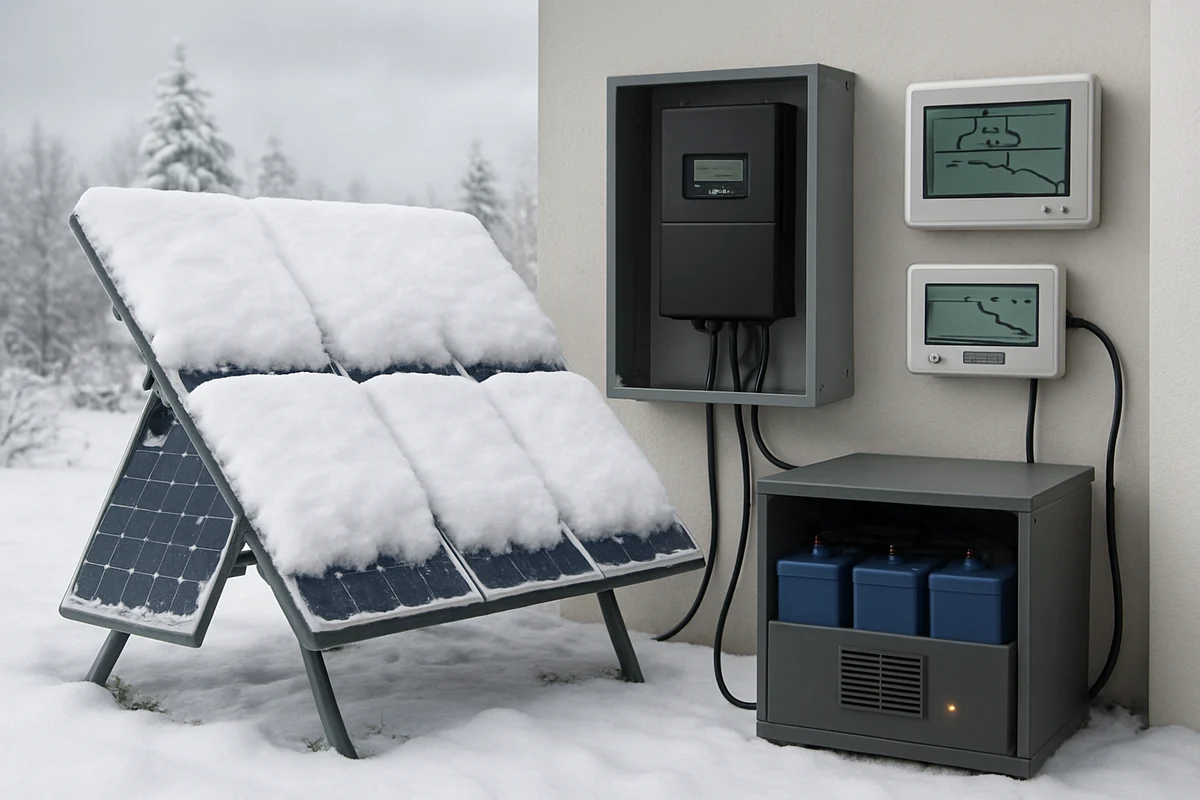
For solar, check array cleanliness and snow strategy. A light dusting can cut output dramatically, and a snow edge can shade cells even when the rest of the panel looks clear. For wind, inspect furling or braking behavior and confirm the controller’s cut-in and cut-out settings match your turbine model. If you rely on a generator, test generator charging at the same battery state you expect after a normal winter day, not only after a full depletion event.
Stress Heat And Water Safety
Heat testing should include both steady operation and worst-case interruptions. If you use propane, verify burner ignition and venting performance with the system cold-soaked, then confirm that wind does not reverse draft. If you use electric heat, calculate the continuous draw and compare it to your inverter and battery discharge limits; a battery that can handle a short burst may not handle hours of resistance heat. For water, run a freeze-risk test: confirm insulation coverage, test heat tracing with a thermometer, and verify pump priming after a cold night.
Use a simple decision rule: if a component depends on power to prevent freezing, treat it as a critical load and plan redundancy. A common aside from winter logs: people often insulate pipes but forget the valve bodies and pump housings, which freeze first because they hold less surrounding heat. A small temperature probe near the most exposed section can show whether your heat tracing actually reaches the coldest point.
Run Safety And Maintenance Checks
Winter increases the consequences of small faults. Inspect battery venting (for vented lead-acid), check fuse ratings and cable routing, and verify that the inverter’s grounding and bonding match the manufacturer guidance. Test smoke and carbon monoxide alarms if you use combustion heating; cold weather can change airflow patterns and exhaust behavior. If you use a generator, confirm exhaust clearances and check that fuel lines and filters remain within operating temperature.
Keep a written checklist and record results with dates. I’ve seen systems where the inverter firmware was updated (for example, version notes from the vendor’s release page) and the low-voltage cutoff behavior changed; without logs, the owner cannot tell whether a shutdown came from weather or settings. A short log format works: date, outdoor temperature, battery temperature, battery state at start, load duration, and observed alarms.
Case Examples
Example 1: Solar + Lithium Battery, Cloudy Cold Week
A household in a snowy region starts the week with a battery state of charge around 60%. During two overcast days, solar charging current stays low because the battery management system limits charge when cells are cold, and the inverter reduces available power when voltage sags. The owner runs a controlled load test on day three: they power a well pump and a small heater fan for 45 minutes while logging battery voltage and inverter warnings. The results show that the system shuts down only when the battery temperature drops below the manufacturer’s charging threshold, not when the state of charge alone reaches a low value. The fix is to improve battery insulation and adjust charge settings to match the temperature sensor placement.
Example 2: Propane Heat + Off-Grid Well Pump
A family uses propane for space heating and a DC well pump powered through an inverter. After a cold night, the pump fails to prime because the pump housing and check valve freeze near the well head. The power system remains stable, but the water system fails first. They run a winter test by measuring pipe and pump housing temperatures during a normal evening and during a simulated power interruption. The test shows that heat tracing covers the pipe run but not the valve body. The repair focuses on adding insulation and extending heat tracing to the coldest fittings, then retesting after a second cold night.
Comparison Table And Checklist
| Test Area | What To Measure | Winter Failure Signs | Likely Fix Direction |
|---|---|---|---|
| Battery + Inverter | Battery voltage under load, inverter alarms, runtime during a 30–60 min load | Low-voltage cutoff, repeated restarts, voltage sag beyond expected | Check wiring voltage drop, verify cutoff settings, improve battery temperature management |
| Charging (Solar/Wind) | Charge current trend, absorption duration, temperature-compensated setpoints | Charging stalls early, controller reports temp-related limits, slow recovery after cloudy days | Confirm sensor placement, clean panels, adjust charge parameters to match battery chemistry |
| Heat System | Ignition reliability, venting behavior, continuous power draw if electric heat | Hard starts, draft problems, inverter overload during long cycles | Verify venting clearances, size electrical loads, test with cold-soaked equipment |
| Water + Plumbing | Pipe and valve temperatures, pump priming after cold night | Frozen fittings, pump cavitation, pressure loss after thaw | Add insulation to fittings, extend heat tracing, confirm pump location and priming strategy |
Step-by-step winter test checklist
- Pick one “normal winter day” scenario and one “cold recovery” scenario, then write down the starting battery state and expected loads.
- Log outdoor temperature, battery temperature, and inverter/charger status at test start.
- Run the heaviest realistic load for 30–60 minutes while watching voltage and alarms.
- Run a charging observation window for several hours, noting charge current and any temperature-related limits.
- Test water freeze risk by checking the coldest exposed fittings after a cold night.
- Record results, then change only one variable at a time so you can interpret what improved.
Common Mistakes
Owners often skip temperature sensors and assume the charger “knows” battery conditions. Many systems require correct sensor placement because battery temperature affects charge voltage and charge current limits. If the sensor sits in a warm enclosure while the battery sits in a cold compartment, the charger can behave incorrectly and shorten battery life.
Another mistake is testing only during the day. Solar output peaks around midday, while winter evenings drive the highest net load. A system that charges fine at noon can still fail at 9 p.m. when loads run and charging stops. Run at least one test that spans evening hours so you see the full cycle.
People also underestimate starting surges. A well pump, refrigerator compressor, or blower can trip inverter protection even when the average power looks safe. Use logging or a clamp meter to capture peak current, then compare it to inverter surge ratings and battery discharge limits.
Finally, some owners treat generator use as a substitute for system sizing. If the generator runs every time the battery drops below a certain level, the system may still be under-sized for winter recovery. A better approach is to test recovery after a typical cloudy period and then decide whether generator runtime, battery capacity, or load management needs adjustment.
FAQ
How cold should I test?
Test at the lowest temperatures you expect during winter, or at least during a sustained freeze period. If you cannot reproduce the absolute minimum, test at a realistic cold range and document battery temperature so you can interpret charging limits.
How do I know my battery is undercharging?
Look for repeated failure to reach absorption or float stages during charging windows, plus low state-of-charge recovery after cloudy days. Battery monitors that report charge stage transitions help, but chemistry-specific behavior matters.
What load is best for a winter stress test?
Use the largest continuous load you run in winter plus a realistic starting event such as a pump cycle. A 30–60 minute run with logged voltage and alarms shows whether the inverter’s cutoff and surge handling match your conditions.
Can snow on panels damage the system?
Snow generally reduces output rather than damaging panels, but partial shading can create hot spots if panels are not designed for it. Keep an eye on abnormal temperatures and avoid scraping panels in ways that damage surfaces or wiring.
How do I prevent frozen water lines?
Insulate the entire run and the fittings, then test the coldest points with a thermometer after a cold night. If you use heat tracing, verify it reaches valve bodies and pump housings, not only straight pipe sections.
Author's Insight
Winter testing works because it forces the system into the same constraints that cause failures: cold battery behavior, reduced charging, higher heating demand, and freeze risk at exposed plumbing points. The most reliable results come from logging temperatures and electrical behavior during realistic load and charging windows, not from quick “it turns on” checks. When you change settings, change one variable at a time and record dates so you can connect cause and effect. If you lack manufacturer guidance for charge profiles or inverter cutoffs, treat those settings as safety-critical and consult the equipment manuals before adjusting.
Key Takeaways
- Test under cold, low-sun conditions and include evening loads so you see the full winter cycle.
- Log battery temperature, voltage under load, and charge-stage behavior to interpret failures correctly.
- Stress-test starting surges like pumps and blowers, not only average power.
- Freeze protection depends on fittings and pump housings as much as straight pipe insulation.
- Use one-variable-at-a-time changes and keep dated notes so improvements stay measurable.