Strategic Civic Dynamics
Navigating the governance of a small town is less about rigid legal codes and more about understanding the "unwritten constitution" of the community. In towns with populations under 20,000, decisions are often made by volunteer boards—your neighbors, local shop owners, or retired professionals—who prioritize community character over rapid economic expansion.
Practical experience shows that a project's success is often determined 60 days before the first public hearing. For instance, in a recent mixed-use development project in upstate New York, the developer spent three months attending PTA meetings and local diners before submitting a single permit. This "soft launch" approach reduced public opposition by 40% compared to previous efforts in the same county.
According to the National League of Cities, over 70% of local officials in small jurisdictions cite "citizen pushback" as the primary reason for denying zoning variances. Furthermore, data from Zillow and the Urban Institute suggests that localized NIMBY (Not In My Backyard) sentiment can increase project costs by an average of $15,000 to $50,000 per unit due to litigation and redesigns.
The Power of Informal Governance
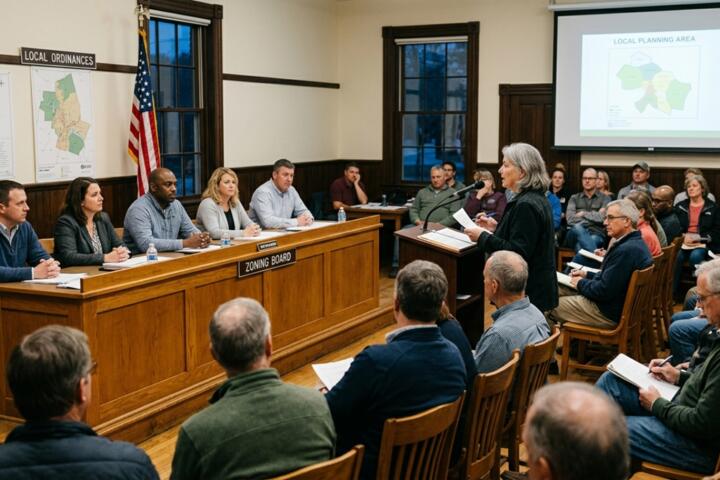
In small towns, the person holding the gavel at the Planning Board meeting often has a day job as a local insurance agent or farmer. They operate on social capital. If you enter the room acting like a "big city developer" with a fleet of lawyers, you have already lost. The informal power structure includes the town clerk and the long-time residents who influence opinion at the local library or coffee shop.
Interpreting Local Ordinances
Zoning codes in small towns are frequently outdated, sometimes not having seen a major revision since the 1980s. This creates a "gray area" where interpretation is subjective. Tools like Municode or General Code allow you to research digital versions of these laws, but the real insight comes from reviewing the minutes of the last three years of board meetings to see how past precedents were set.
Building Sustainable Coalitions
You cannot win a zoning battle alone. Successful navigators build a coalition of "pro-growth" voices, such as the local Chamber of Commerce or young families looking for affordable housing. Using platforms like Nextdoor or Facebook Groups to monitor sentiment—not to argue, but to listen—is critical for identifying who your supporters might be before a heated public session.
Strategic Pitfalls
The most frequent error is treating a small-town zoning board like a technical hurdle rather than a social one. Relying solely on "by-right" legal arguments ignores the political reality that board members are elected or appointed by people who fear change. When you prioritize legal jargon over community benefit, you invite a "death by a thousand cuts" through endless requests for additional studies.
This matters because small municipalities have limited budgets. If a project looks like it will strain the local sewage system or increase traffic near an elementary school, the board will lean toward "No" to avoid the risk. The financial consequences are severe; carrying costs on a property while waiting for a Special Use Permit can erode a developer's profit margin by 2% every month of delay.
In a 2023 case in Ohio, a commercial project was stalled for 18 months because the developer failed to consult with the local Historical Society. The resulting legal fees and lost opportunity costs exceeded $200,000—a sum that could have been avoided with a $500 donation to the town's heritage festival and a 30-minute introductory meeting with the Society's president.
Engagement Tactics
To succeed, you must adopt a "Radical Transparency" model. Start by hiring a local land-use attorney or a civil engineer who has already worked with the town. They have the rapport that an outsider lacks. Use Esri’s ArcGIS to create high-quality visualizations of the project that show exactly how it fits into the existing skyline, minimizing the fear of the unknown.
This works because visual evidence overrides emotional speculation. When a neighbor says, "That building will block my sunlight," and you can show a 3D shadow study created in SketchUp proving otherwise, the board has the political cover they need to vote "Yes." Data-driven presentations provide the objective facts required to counter subjective complaints.
On the ground, this looks like hosting an "Open House" at a local community center—not a formal meeting—where you serve refreshments and have stations explaining traffic, noise, and environmental impact. At one such event in Vermont, a developer used Remix (a transit planning tool) to show how their project would actually improve local bus flow, turning 15 vocal opponents into neutral observers.
Engaging the Town Engineer Early
Before your public hearing, request a "pre-submission conference." Bring your plans to the town engineer and the building inspector. Ask them, "What are the common complaints you hear about projects like this?" Addressing their technical concerns in the first draft shows respect for their expertise and saves you from costly revisions during the official review phase.
Quantifying the Tax Base Benefit
Small towns are often cash-strapped. Use Urban3’s "Value per Acre" analysis to show exactly how much your project will contribute to the local tax base compared to the cost of services it will require. If you can prove your project brings $50,000 in annual tax revenue while only costing $5,000 in road maintenance, the economic argument becomes difficult for the board to ignore.
Leveraging Environmental Certifications
Voluntary compliance with green standards, such as LEED or the Passive House Institute, can act as a powerful olive branch. In many "green-leaning" small towns, showing that your building will be net-zero or will preserve 40% of the existing tree canopy can bypass traditional aesthetic objections. It aligns your interests with the town’s long-term sustainability goals.
Proactive Traffic Mitigation
Traffic is the #1 objection in 90% of zoning cases. Instead of waiting for a mandated study, commission a proactive Traffic Impact Study (TIS) using a reputable firm like Kimley-Horn. Presenting a plan that includes a new turning lane or a signal synchronization at your own expense demonstrates that you are a partner in the town’s safety, not an interloper.
Utilizing Local Media Relations
Small-town newspapers (or their digital equivalents like Patch) still hold immense power. Draft an Op-Ed or a "Letter to the Editor" explaining why your project helps the town’s youth stay in the area or how it revitalizes a derelict lot. Controlling the narrative in print helps prevent the spread of misinformation on social media, where rumors often outpace reality.
Project Success Profiles
The Mill District Revitalization (Mass.): A developer wanted to convert an old warehouse into loft apartments. The local board was concerned about "gentrification." The developer partnered with a local non-profit to set aside 15% of units for teachers and first responders. By using CoStar data to show the lack of housing for essential workers, they gained unanimous approval in 4 months. The result was a 100% occupancy rate within 30 days of opening.
The Rural Broadband Initiative (Iowa): A small ISP needed zoning variances for three towers. Initial pushback centered on "visual blight." The company utilized TowerSource to find existing structures to co-locate on, reducing the need for new towers. They presented a "Community Benefit Agreement" that provided free Wi-Fi to the local park. Approval was granted in 60 days, and the company saw a 22% ROI in the first year due to low acquisition costs.
Decision Framework
| Action Item | Primary Tool/Service | Impact on Approval |
|---|---|---|
| Community Sentiment Analysis | Nextdoor / Social Listening | High (Identifies "NIMBY" leaders) |
| 3D Impact Visualization | SketchUp / ArcGIS | Very High (Reduces fear of change) |
| Economic Impact Modeling | Urban3 / ImpactCheck | Medium (Satisfies fiscal conservatives) |
| Ordinance Research | Municode / General Code | High (Ensures legal compliance) |
| Traffic Pattern Analysis | StreetLight Data | High (Mitigates safety concerns) |
Common Errors to Avoid
Avoid the "Last Minute Surprise." Never present a significant change to your site plan on the night of the meeting. This makes board members feel ambushed and forced to delay a vote to "study the changes." If you have a revision, get it to the planning office at least 10 days before the session so the staff can vet it.
Don't ignore the "Gatekeepers." The administrative assistant at the Town Hall often knows more about the board's temperament than the Chairman. Treating the staff with disrespect is a guaranteed way to have your paperwork "lost" or delayed. Consistent, polite communication with the municipal staff is your most effective lubricant for the gears of bureaucracy.
FAQ
How do I handle a vocal 'NIMBY' group?
Invite their leaders to a private meeting before the public hearing. Listen to their concerns without getting defensive. Often, making a small concession (like changing a paint color or adding a fence) makes them feel heard and lowers the temperature of the public debate.
What if the zoning board denies my request?
Most small towns have a Zoning Board of Appeals (ZBA). You can appeal based on "hardship" or a "procedural error." However, your first step should be to ask for a "denial without prejudice," which allows you to resubmit a modified plan without a waiting period.
Is it worth hiring a lobbyist for a small town?
Rarely. In a small town, a "lobbyist" can look suspicious. You are better off hiring a local architect or engineer who lives in the county. Their personal reputation carries more weight than a professional advocate's polished pitch.
How can I speed up the permit process?
Ensure your application is 100% complete. Incomplete applications are the #1 cause of administrative delays. Use a checklist provided by the town and double-check every signature and fee before submission.
How do I find out about upcoming zoning changes?
Subscribe to the town’s official registry and monitor the "Legal Notices" section of the local newspaper. Many towns now use services like CivicPlus to send automated alerts for board agendas and minutes.
Author’s Insight
In my fifteen years of navigating municipal approvals, I have found that the most successful projects are those where the applicant behaves like a neighbor, not a visitor. I once saw a $10 million project move forward simply because the developer agreed to preserve a 100-year-old oak tree that the town’s founder had planted. My advice: find the one thing the town is irrationally proud of and protect it. This builds "psychological equity" that you can spend when you need a technical variance later.
Summary
Navigating the political landscape of a small town requires a blend of data-driven preparation and high-touch relationship management. By utilizing modern visualization tools, respecting local hierarchies, and addressing community concerns proactively, you can transform a potential conflict into a collaborative success. Your immediate next step should be to download the last three sets of planning board minutes and identify the most frequent objections raised by the community.